
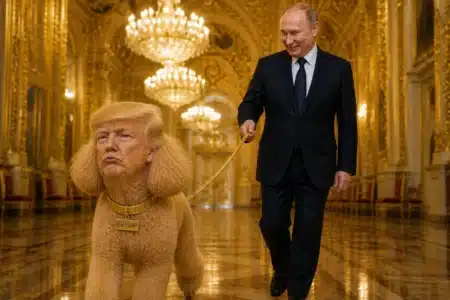
Of all the political narratives that have emerged over time, very few have been as persistent or as controversial as that surrounding the claim that Donald Trump maintains an overly friendly approach toward Vladimir Putin. While for some the narrative seems like an over-exaggerated partisan rant, there is certainly something else behind the persistence of such a view.
The reason why the narrative persists lies in the fact that it does not revolve around any one-off statement or event; instead, it is based on a number of rhetorical devices, frameworks, and discursive emphases. More importantly, however, critics today tend to see such an approach to rhetoric as potentially feeding into pro-Russian narratives.
A Different Kind of Foreign Policy Language
Since his early days in the Oval Office, Trump’s policy towards Russia differed markedly from that of other American presidents. While previous incumbents saw the former Soviet state as a rival player in global politics, Trump emphasised ideas of dominance, leadership, and partnership potential.
The 2018 Helsinki Summit, when Trump seemed to question the credibility of the intelligence reports on Russian meddling in the elections by standing next to Putin, became another such episode. For many, it signaled a readiness to cross certain red lines that earlier American presidents would not dream of crossing.
For the defenders of Trump, on the contrary, such rhetoric was part of the strategy. Even though policies toward Russia, sanctions included, have been rather stringent, the rhetoric has never been.
Echoes of the Kremlin Line
This contrast becomes even more apparent when it comes to analyzing Trump’s rhetoric on Ukraine itself.
On several occasions, Trump has described the conflict in such a way that one may observe an almost deliberate mirroring of the Kremlin’s narrative, stressing Russia’s capabilities, implying that Ukraine lacks the means of winning the war, and arguing for the inevitability of a settlement favorable to all sides.
In this sense, no actual coordination is required. Indeed, according to critics of Trump’s policies, the president can serve as an echo chamber or a megaphone without actually endorsing or even knowing what the other party is doing because he can legitimise ideas that come from elsewhere just by mentioning them.
And here we have the explanation behind this specific term. It is neither support nor endorsement; it is mere mirroring with the same result.
When the “Deal” Becomes the Message
In the centre of that perspective lies Trump’s fundamental nature: Everything is a deal yet to be struck.
In business, this can be a good approach. On the battlefield, this can be misleading.
This is not a negotiation over some real estate deal gone awry. This is a battle over sovereignty, borders, and survival. But Trump’s view of this situation tends to boil things down into something simpler: Two parties, a table, and a deal that just needs to be made sooner rather than later.
The trouble is, as one critic notes, when you prioritise speed, substance goes out the window. If a deal has to be made now, then it doesn’t make sense to resist anymore, it doesn’t make sense to hold out, and it doesn’t make sense not to negotiate from your current position of strength.
These views are far from innocent. They mirror Russian messaging in key ways: Russia holds the upper hand, Ukraine does not have the capacity to change the course of events, and the “realistic” endgame is a peace agreement that solidifies its gains.
This is how the dealmaker impulse fuels the megaphone effect. Trump does not have to stick to a script. He can use the idea that the problem is one that needs to be solved swiftly and with a compromise to reinforce his strategic story: that time and inevitability are on Russia’s side.
The Deal as Performance
This idea receives even more attention from critics, who argue that not only is “making a deal” about strategy – it’s personal.
For instance, Trump himself has continually spoken about his involvement in solving international problems, or in easing tensions between certain nations. Moreover, Trump has openly admitted his disappointment in the lack of any appreciation on his part of making deals that contribute to peace in some way. This sentiment sometimes even leads him to make jokes about the Nobel Peace Prize, which is seen as the final stamp of approval for a successful deal-maker.
In this regard, the very process of making a deal can be seen as a performance, where the result becomes a source of personal prestige.
In this case, the incentives change. Instead of working simply towards achieving an end to the conflict, the objective becomes one of appearing to achieve it.
This leads to a possible discrepancy, as the real estate transaction can be assessed when it is concluded, while the peace deal will be judged years down the road as to its success, its effectiveness in deterring future aggression, and its ability to address the root causes of the conflict.
The concern with focusing on speed and visibility, it is claimed, is that the deal may become the final point, instead of marking only the start of a sustained peace process.
A Changing Reality on the Ground
What makes this even more complicated is the fact that the balance of power underneath it all is evolving.
For one thing, Ukraine has become far less reliant on the United States than it was when the war first started. Countries in Europe, including via alliances such as NATO and through bilateral agreements, have increased their military and financial assistance to Ukraine. Additionally, Ukraine has gained a reputation for quick and effective innovations, especially in drone warfare and battlefield technology.
This is significant because it undermines one of the major underlying premises of the “quick deal” approach, which is that the United States has enough influence in the situation to determine or negotiate the final outcome.
In reality, any lasting settlement will have to be coordinated among not only the United States and Russia but also between Kyiv and its allies in Europe.
Amplification in a More Complex World
However, the message remains the same.
This is precisely the problem with the criticism of the West’s approach towards resolving the crisis in the Ukraine-Russia standoff: the rhetorical pressure of making a quick decision that fits well within the discourse of Russian strength and Ukrainian weakness despite all the changes in the strategic realities.
In such a way, what can be called the “megaphone effect” goes beyond repeating the same statements over and over again; instead, the rhetoric promotes an entire perception in which the war is over in favour of Russia, and prolonging it is not practical, and all the efforts should go into getting the deal done.
Whether this is realistic or an ego-driven approach to international affairs is open to debate depending on one’s stance.
But as Ukraine develops its response to this situation, and Europe begins to play a more active role in solving it, there seems to be only one conclusion to draw from all this:
A deal made must be a deal that can be lived with.
The difference between the two could sum up the whole argument.
Comments (0)