
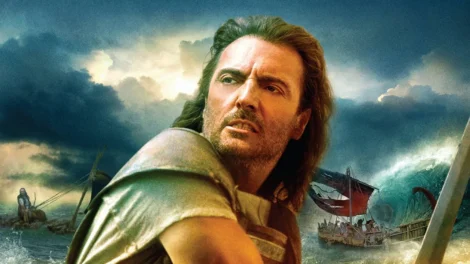
Every few years Hollywood rediscovers Homer, dusts off The Iliad or The Odyssey, and proudly announces that this time they’re going to get it right.
Not because Homer got it wrong, you understand.
Just because the greatest storyteller in Western history apparently needs the help of a room full of executives, script doctors and marketing consultants who think “storytelling” is something you measure with focus groups.
The press tour is always the same.
“We wanted to make it relevant for modern audiences.”
That phrase has become the cinematic equivalent of hearing your mechanic say, “We’ve had to improvise.”
Relevant?
Achilles’ rage. Hector’s honour. Priam’s grief. Odysseus’ desperate longing to get home. Penelope’s unwavering loyalty. These stories have survived almost three thousand years. They’ve outlived the Bronze Age, the Roman Empire, the Renaissance, the Industrial Revolution, two World Wars, disco, New Coke and whatever the hell the metaverse was supposed to be.
Yet somehow they’re only now becoming relevant.
The sheer arrogance is breathtaking.
Imagine looking at a work that has shaped literature for nearly thirty centuries and saying, “Yes… but I think Homer needs another pass.”
The assumption now seems to be that every ancient story must be filtered through whatever moral, political or cultural lens happens to be fashionable this week. Characters are reinvented, relationships rewritten, motivations replaced, mythology stripped away, and before long you’re no longer adapting Homer—you’re writing fan fiction with a famous title attached because that’s easier to market.
If a filmmaker wants to tell a different story, fine.
Tell a different story.
Just don’t wrap yourself in Homer’s reputation while pretending you’ve somehow improved him.
One thing that particularly grates is the smug certainty that accompanies it all. It’s not simply an adaptation—those have existed for centuries. It’s the implication that the original text was somehow deficient. That Bronze Age Greece was just crying out for a twenty-first-century writers’ room to straighten everything out.
You can almost hear the meeting.
“Not enough women?”
“Hold my beer.”
“Too many gods?”
“Confusing.”
“Heroes aren’t relatable enough.”
“Let’s fix that.”
“And make sure everyone speaks exactly like people living in Los Angeles in 2026.”
Meanwhile, many of the actors dutifully repeat the approved interpretation in interviews as though the screenplay itself is the source material. You rarely hear, “I spent months reading Homer.” Instead, it’s, “The director wanted us to explore what these characters mean today.”
That’s lovely.
I’d quite like to know what Homer thought they meant first.
Now, here’s a thought experiment.
Imagine the exact same people announcing they’re remaking The Bible.
Not faithfully.
Not as an adaptation.
No…
For modern audiences.
Press release:
“After extensive consultation with marketing executives, social media strategists and people who’ve never actually read the source material, we’re delighted to unveil the definitive Bible for today’s viewers.”
Genesis has been shortened to a ninety-second montage because audiences have short attention spans.
Adam and Eve don’t eat from the Tree of Knowledge—they accidentally spread misinformation online.
The serpent is now a misunderstood anti-hero with his own streaming spin-off.
Noah only takes the cute animals because the CGI budget is tight.
The Ten Commandments have been updated into “Ten Helpful Suggestions.”
The burning bush is now an AI hologram.
David doesn’t defeat Goliath. They work through their differences with the help of a mediator.
Jonah and the whale discover that the real journey was learning to love themselves.
The Last Supper serves oat milk.
Water isn’t turned into wine because of responsible drinking guidelines.
Judas isn’t a traitor.
He simply has a different perspective.
The Crucifixion tested poorly with focus groups, so everyone sits in a circle and shares their feelings instead.
The Resurrection has been moved to the end of Act One because audiences expect a faster pace.
The Devil is no longer evil.
He’s simply challenging the established narrative.
Post-credit scene:
Moses walks through a glowing portal.
“Odin… I’ve heard you’re putting a team together.”
The Scriptures Cinematic Universe begins.
Can you imagine the reaction?
The internet would melt.
Newspapers would devote editorials to it.
Television debates would run for weeks.
People would quite rightly ask why anyone thought they knew better than one of the foundational texts of an entire civilisation.
And yet…
Swap The Bible for Homer, and suddenly it’s hailed as bold, courageous and necessary.
Why?
Why is one ancient text expected to be approached with humility, while another is treated like an old screenplay that simply needs updating?
Here’s the uncomfortable truth.
The Iliad and the Odyssey do not need fixing.
They need understanding.
Hollywood keeps asking how to make Homer relevant.
Perhaps it should ask itself why Homer is still being read after nearly three thousand years, while most of the films proclaiming themselves “for modern audiences” are forgotten before the streaming licence expires.
Maybe the modern audience isn’t the problem.
Maybe the problem is an industry so morally and intellectually bankrupt that it mistakes rewriting greatness for surpassing it.
Homer doesn’t need Hollywood.
Hollywood desperately needs Homer.
It just hasn’t realised it’s the student, not the teacher.
Comments (0)